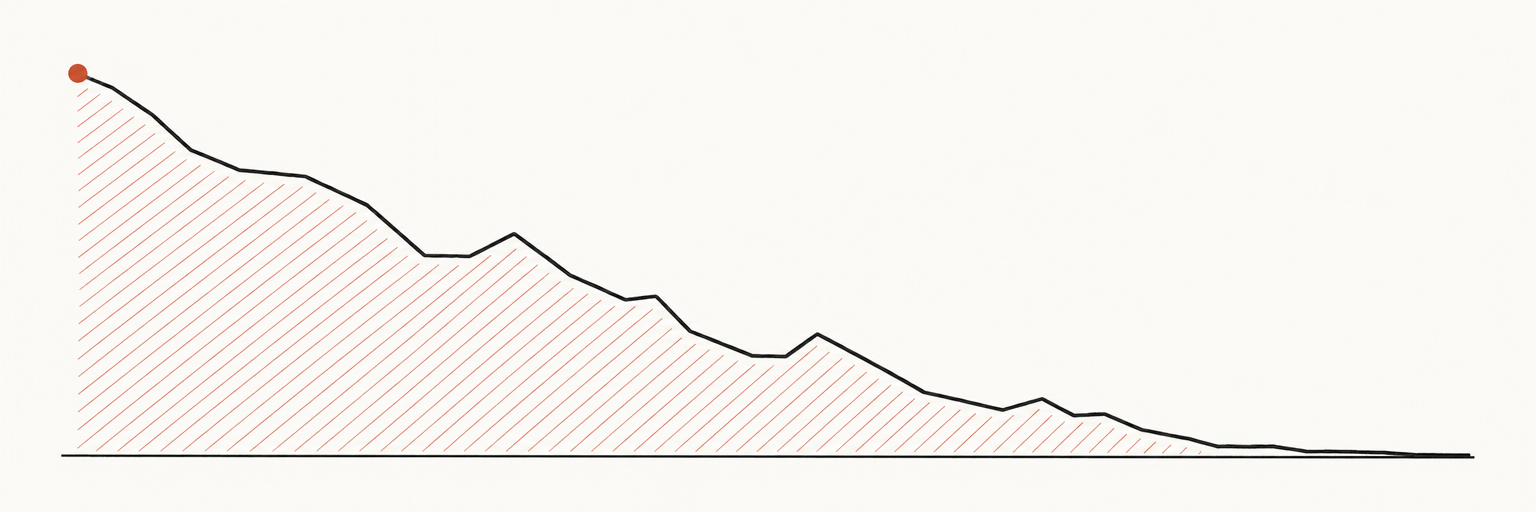
Credit card debt is expensive — most cards charge 20–30% APR. Every month you carry a balance, you’re paying for the privilege of having spent money you didn’t have. Here’s how to get out.
The two strategies
Debt avalanche (mathematically optimal)
Pay minimums on all cards. Put every extra dollar toward the highest-interest card first.
- Saves the most money in interest
- Takes the same or less time
- Best if you’re motivated by math
Debt snowball (psychologically effective)
Pay minimums on all cards. Put every extra dollar toward the lowest balance first, regardless of interest rate.
- Pays slightly more in total interest
- Builds momentum with quick wins
- Best if you need to see progress to stay motivated
Pick the one you’ll actually stick with. For most people with a mix of small and large balances, avalanche wins financially but snowball wins behaviorally.
How to find extra money
You need more than the minimums to make real progress:
- Pause discretionary subscriptions for 3–6 months
- Sell things — unused gear, clothes, furniture (Facebook Marketplace, eBay)
- Add income — one extra shift, freelance work, odd jobs
- Cut one major category — eating out, or a recurring expense you can trim
Even an extra $200/month changes the timeline significantly.
Example: $5,000 at 24% APR
| Payment | Months to pay off | Total interest paid |
|---|---|---|
| Minimum only (~$100) | Never fully clear | Thousands |
| $200/month | 32 months | $1,375 |
| $400/month | 14 months | $567 |
| $600/month | 9 months | $360 |
Doubling your payment roughly halves the time and the interest cost.
Balance transfers: worth it?
A 0% APR balance transfer card can help if you have decent credit. You move your high-interest balance to a new card with 0% for 12–21 months, pay it down interest-free during that window.
Caveats:
- Balance transfer fee is usually 3–5% of the amount
- You need good credit to qualify
- If you don’t pay it off before the promo ends, the rate jumps
- Don’t use the old card and add new debt on top
Stop going back into debt
The payoff only sticks if you fix what caused it:
- Build a $1,000 emergency fund before aggressively paying debt — it prevents new debt from unexpected expenses
- Freeze or cut the cards you consistently overspend on
- Look at where the spending came from — the card wasn’t the problem, it was just the mechanism
Getting out
Pick a strategy, find extra cash each month, apply it to debt in order. 1–3 years is realistic for most people with typical credit card balances. The math isn’t complicated — starting is the hard part.